

Click on the article title below to be taken directly to the article. After you’re done reading the article, click “Back to Top” at the bottom to be brought back to the Table of Contents.
Table of Contents
- NAAA Meets with FAA Administrator Bryan Bedford and Additional FAA Leadership to Discuss FAA UAS BVLOS Proposed Rule
- FCC Prohibits Foreign UAS Authorization; Existing Models Unaffected
- Start the Year with a New 2026 NAAA Membership!
- Top 10 Agricultural Aviation Articles of 2025
- Don’t PAASS Up Safety Education – Attend the 2025-2026 PAASS Program, Collect CEU’s, Qualify for C-PAASS and Fly Safe
- NAAA & NAAREF Board Meetings Feb. 12-14 in Alexandria, VA, All Members Invited
NAAA Meets with FAA Administrator Bryan Bedford and Additional FAA Leadership to Discuss FAA UAS BVLOS Proposed Rule
On January 6, 2026, the NAAA participated in a roundtable event with FAA Administrator Bryan Beford, FAA Deputy Administrator Chris Rocheleau, other key FAA officials and general aviation, airline pilot, aviation first responders, air traffic control, and unmanned aircraft organization leaders to discuss challenges, concerns, and recommendations related to the FAA’s UAS beyond visual line of site (BVLOS) proposed rule. Representing NAAA at the meeting was Andrew Moore, CEO. A significant portion of the meeting’s focus was on detect and avoid devices, such as ADS-B and electronic conspicuity (EC) and if they are reliable and effective in creating a safe separation between manned and unmanned aircraft. At the meeting drone interests advocated their support of equipping with ADS-B/EC devices and stated that they have collected well over a decade of drone flight data, also stating there have been minimal accidents. Manned aviation interests did raise the issue of ADS-B not being a fail-safe for traffic deconfliction due to signal loss in certain circumstances. Moore stated to the roundtable that ag pilots have had issues with ADS-B signals at low altitudes when operating around rolling hills and dense tree cover. He also stated, along with a number of other manned aircraft leaders, that EC aircraft detection devices were the preferred technologies due to their anonymity and would result in more manned aircraft users equipping with them to keep public tax and user fee authorities and litigious entities at bay.
Moore stated to the roundtable that aerial applicators are flying in the same airspace as drones, under 400 feet when they are making turns and applications, and that they have additional obstacles to avoid, such as utility poles, wires, towers, etc. As such, he raised serious concerns to the roundtable, and, separately, to the administrator after the meeting, the proposed rule’s shielded area language that allows drones operating within 50 feet vertically or horizontally of wires, rights-of-way, obstacles, etc. to do so without equipping with ADS-B/EC or to give right of way to a manned aircraft. Moore stated that since these shielded area drone interests would be operating commercially and in the vicinity of needed manned applications to cropland, they should be required to equip with ADS-B. Similar safety concerns from other individuals about the shielded area language were echoed, including from unmanned interests.
A separate roundtable meeting with unmanned companies was held earlier in the day, January 6th, with the FAA administrator and others in FAA leadership. Attending that meeting were NAAA drone operator members Joel Jones of Drone Crop Services in Arkansas, and Jeramy Williams of American Drone in Wisconsin where they emphasized greater involvement of drone regulatory compliance through local FAA FSDO inspectors in overseeing Part 108 operators.
The release of the FAA’s UAS BVLOS final rule is still uncertain, however, President Trump’s executive order June 2025 directing release of the rule set a final deadline for early 2026. The Transportation Security Administration must also sign off on the rule. Comments made by NAAA and others at the January 6th roundtable meeting will be included in the docket of the FAA UAS BVLOS rule.
FCC Prohibits Foreign UAS Authorization; Existing Models Unaffected
In December, the Federal Communications Commission (FCC) received from the Executive Branch interagency body (which includes the appropriate national security agencies) a specific determination that Uncrewed Aircraft Systems (UAS) and UAS critical component parts that are produced in foreign countries should be included on the FCC’s Covered List.
The FCC’s Covered List is a list of communications equipment and services that are deemed to pose an unacceptable risk to the national security of the U.S. or the safety and security of U.S. persons. Equipment on the Covered List is prohibited from getting FCC equipment authorization, which is required for importation, marketing or sale in the U.S.
The FCC cannot update this list on its own and is required to implement determinations that are made by our national security agency experts. In their determination, the national security agencies referenced, among other things, concerns that foreign-made UAS could be used for attacks and disruptions, unauthorized surveillance and sensitive data exfiltration. Additionally, the determination noted that reliance on such devices unacceptably undermines the U.S. drone industrial base.
Crucially, this update to the Covered List does not prohibit the import, sale or use of any existing device models previously authorized by the FCC. In other words, previously purchased UAS and UAS already on the market are not affected.
New foreign made UAS and UAS critical components will, going forward, be prohibited from receiving FCC authorization and are therefore prohibited from being imported for use or sale in the U.S. For perspective, these UAS critical components include, but are not limited to:
- Communications Systems
- Flight Controllers
- Navigation Systems
- Sensors and Cameras
- Batteries and Battery Management Systems
- Motors
To stakeholders in the Uncrewed Aerial Application System (UAAS) industry who have been following this issue closely, this action was not overly surprising and fits into the consistently messaged broader intent of the administration to transition toward U.S.-based drone manufacturing and reduced reliance on foreign suppliers.
While this will certainly spur new UAAS development by U.S. manufacturers, current UAAS operators can rest assured that parts for their existing FCC-authorized models will remain available, they can continue using aircraft they currently own, and models with existing FCC authorizations will still be permitted to be sold and utilized.
Start the Year with a New 2026 NAAA Membership!
Thank you for your 2025 NAAA membership. As we celebrate NAAA’s 60th anniversary this year, we request your continued support by renewing your NAAA membership because it is vital to keeping our industry strong, safe and well-represented. While you’ve been hard at work helping farmers produce a safe, affordable, and abundant supply of food, fiber, and bioenergy, NAAA has been working hard to ensure the low-altitude airspace is safe for your aerial application business, as well as ensuring that you have the pesticide products you need to do your job.
Your NAAA membership will continue to provide valuable benefits that support your business and that have protected the industry for 60 years. Receive discounts for attending or exhibiting at the Ag Aviation Expo, Nov. 16-18 in Savannah, GA; access to the 2026 NAAA Membership Directory in both print and online formats to connect with fellow members; and stay informed through the new NAAA 365 App, our publications, eNewsletters, social media updates, and in-depth online content at AgAviation.org. To renew, log in to your account at AgAviation.org and pay your 2026 membership invoice.
Several of NAAA’s recent accomplishments to help ensure your success include:
- NAAA submitted comments and urged members, non-members and numerous other ag and aviation interests to comment to FAA’s beyond visual line of sight drone proposal, opposing drones the right-of-way over manned aircraft. This issue is of paramount concern to the lives of aerial applicators. NAAA provides evidence-based comments to the FAA defending crewed aircraft’s right-of-way over drones in all circumstances and ensures that the safety concerns of manned aerial application are heard.
- NAAA actively lobbies for critical funding for the USDA-ARS, supporting vital research that directly benefits aerial applicators. Without this ongoing research, including droplet size modeling for pesticide label compliance, our industry would face increased challenges in meeting regulatory requirements. NAAA’s efforts ensure that the science behind aerial application continues to evolve, and NAAA conducts industry surveys and updates EPA drift modeling to ensure label language allows for realistic, not restricted, aerial use of pesticides.
- Since 2017, NAAA has submitted over 300 comments to the EPA to keep aerial application uses on pesticide labels with great success, enabling you to keep a deep inventory of pesticide tools without unnecessary and burdensome restrictions.
- NAAA released an aerial applicator’s Flight Risk Assessment Tool (FRAT) to enhance agricultural aviation safety.
- NAAA and NAAREF continue to grow its education and safety offerings. The online education center, which includes educational videos and C-PAASS certification for aerial applicators who want to augment their safety and professionalism and for the purpose of being rewarded by their insurance providers, pesticide manufacturers, regulators, and customers. Learn more at education.agaviation.org.
- NAAA offers competitive health and life insurance options for members. Visit agaviation.org/membership for details.
We encourage you to renew your NAAA membership today – your investment returns far more in value through strong advocacy that helps reduce burdensome regulations and taxes impacting your aerial application business. Plus, your membership dues are tax-deductible as a business expense.
Back to top
Top 10 Agricultural Aviation Articles of 2025
Agricultural Aviation magazine published many informative articles in 2025. Below is a list of the top 10 digital articles from its 2025 issues based on the most viewed articles at AgAviationMagazine.org/agriculturalaviation/library/ and the magazine’s app.
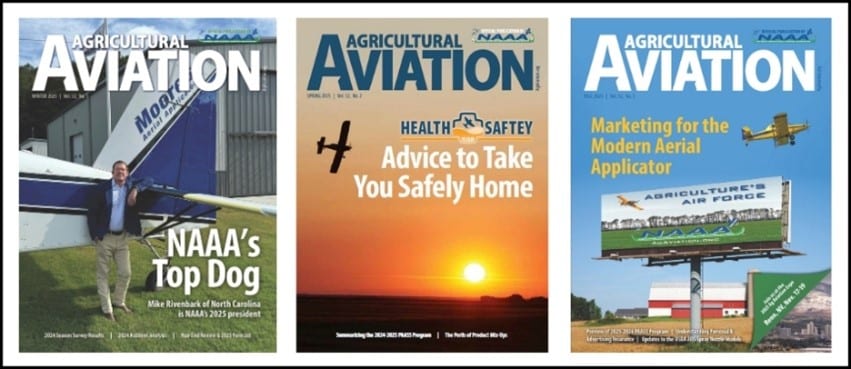
- ADS-B, Anonymity, and UAS: The Intersection of Safety and Privacy – Winter 2025
- Agricultural Aviation Accidents – A Synopsis of 2024 Preliminary Data and Review of 10-Year Accident Trends – Winter 2025
- NAAA’s Top Dog: 2025 NAAA President Mike Rivenbark Profile – Winter 2025
- The Journey of an Ag Pilot: From Dreams to Leadership (Profile of 2025 Vice President Matt Hovdenes) – Winter 2025
- 2024 Industry Survey: A Decent Year for Some Operators, but a Less Productive Year for Others – Winter 2025
- Enhancing Safety & Empowering Members: The Key to our Success (2025 NAAA President’s Winter Message) – Winter 2025
- The Key to Success (2025 NAAA President’s Spring Message) – Spring 2025
- Droning On (NAAA CEO Andrew Moore’s Spring Message) – Spring 2025
- Kevin Humphrey’s Self-Check Pocket Guide (as part of the 2024 Kickoff Breakfast speaker Kevin Humphreys article) – Spring 2025
- By George, He Really Did It This Time (George Parker shares his account of a costly product mix-up) – Spring 2025
Back issues are available in Agricultural Aviation’s Issue Library.
Get the Free Agricultural Aviation App
If you haven’t installed the free Agricultural Aviation Magazine App on your smartphone or tablet, you are missing out on a great and easy way to tap into a library’s worth of back issues. Download the Agricultural Aviation Magazine App and see how easy it is to use. The app is compatible with all Apple, Google and Amazon mobile devices and can be downloaded from their respective app stores by searching “Agricultural Aviation Magazine.” Enable push notifications to be alerted when new digital editions are published and to receive occasional notifications about pertinent articles.
Don’t PAASS Up Safety Education – Attend the 2025-2026 PAASS Program, Collect CEU’s, Qualify for C-PAASS and Fly Safe
There are still several opportunities to attend the 2025-2026 PAASS Program this winter. Find a program here or contact your state/regional association. The PAASS Program covers the latest in aviation safety, environmental stewardship, and best security practices. Some states offer CEUs for PAASS Program attendance which go towards renewing your commercial pesticide license. In addition, PAASS attendance is required to be a certified professional aerial application safety steward (C-PAASS) which may qualify one for insurance discounts, amongst a number of other benefits. Most importantly, the program saves lives — ag aviation accident rates and drift incidents have decreased by nearly 26% since PAASS hit the stage.
The 2025-2026 PAASS program will begin with a review of agricultural aviation accidents from both the 2025 season as well as an analysis of accident trends from the recent past to this year. Accident details examined will include cause of accident, type of aircraft involved, and experience level of the pilot. Studying agricultural aviation accidents allows participants to understand how to avoid similar accidents while conducting aerial applications.
The human factors segment of PAASS covers information on how to reduce agricultural aviation accidents caused by human error. For 2025-2026 the subject will be how to conduct a proper weight and balance for agricultural aircraft. The goal is to reduce the number of takeoff accidents in the industry by ensuring pilots know how to calculate the weight of their aircraft and verify it’s not overloaded for the takeoff conditions. These conditions include density altitude, runway length and surface type, wind speed and direction, and the pilot’s skill level. Ensuring the aircraft is properly balanced is crucial to maintaining control of the aircraft throughout the flight as the hopper is emptied through the application process. A review of takeoff accidents caused by weight and balance errors will be included, as will videos of engineers from agricultural aircraft manufacturers discussing critical concepts. Real world agricultural aircraft examples will be used to convey key topics and to demonstrate how to conduct calculations.
The environmental professionalism segment of the 2025-2026 PAASS program will start with an update on EPA’s Endangered Species Strategies. The operating procedure for checking EPA’s Bulletins Live Two! (BLT) to determine where pesticide use limitation areas (PULA) are located and how to access and interpret the bulletins will be reviewed. New in 2025-2026 will be the wind-directional buffer zones, managed areas that count as buffers, and EPA’s mitigation menu of aerial application technologies and operating parameters that can be used to reduce the buffer distance. Examples from the insecticide and fungicide strategy will be used.
The 2025-2026 PAASS program will include a security segment that highlights the value of having a video surveillance system with a recording capability to provide security over aircraft and chemicals as well as document unexpected occurrences at an operation. An aviation medical examiner will cover how to avoid medications that can impact flying and how to stay properly rested to avoid fatigue. The 2025-2026 PAASS program will conclude with a series of multiple-choice questions asked using polling software to ensure knowledge retention of the material presented by the participants.
NAAA & NAAREF Board Meetings Feb. 12-14 in Alexandria, VA, All Members Invited
The February 2026 NAAA & NAAREF Board and Committee meetings will take place at the Hilton Old Town in Alexandria, VA. Click here to view a schedule of meetings. All meetings are open to NAAA members. If you are not a board or committee member but you’re interested in attending, please contact Lindsay Barber for more details.
Meeting Location
Hilton Old Town Alexandria
1767 King Street
Alexandria, VA 22314
- Rate: $172/night plus tax.
- Room Block Closes: January 20, 2026. Room rates will be higher after block closes, and we cannot guarantee rooms will be available after this date.
- Reservations:
- To book online: https://group.hilton.com/te94ah
- Call 1-800-HILTONS and refer to group/SRP code is 90O (that is 9 zero and the letter O)
- If you have hotel questions or issues, do not book outside the block. Please email Lindsay Barber your arrival and departure dates.
Board Books: All board books are provided electronically. Board and Committee members will receive a link and directions to download the electronic board book approximately one week before the meetings. The board book can be downloaded to your computer, tablet or you can print your committee items.
PAC Breakfast: Join us on Friday morning, Feb. 13th, at 7 a.m. at the Hilton Old Town for the AgAv PAC Breakfast. Congressman David Rouzer (R-NC) has been invited to speak. Further details will be sent in early 2026.
Back to top
In Case You Missed the Last NAAA eNewsletter
Click here for the December 18, 2025 eNewsletter to read:
- Research on Economic Value of Agricultural Aviation Industry Published in Journal of Agribusiness Highlighting a Loss of 24% for Producers if Aerial Application Were Not Available
- Legislation Eliminating Burden of Clean Water Act’s Permits for Pesticide Applications Already Approved for Water Safety Under FIFRA Advances in Congress
- 2025 C-PAASS – Application Closing Friday!
- NAAA & NAAREF Board Meetings Feb. 12-14 in Alexandria, VA, All Members Invited
- Renew Your 2026 NAAA Membership Today
- AStar Cargo Swing Control
- AStar Vertical Fin Spar