

Click on the article title below to be taken directly to the article. After you’re done reading the article, click “Back to Top” at the bottom to be brought back to the Table of Contents.
Table of Contents
- NAAA Advocacy Scores Another Victory in Allowing States Grant HazMat Endorsement Exemptions for Class A CDL Drivers Transporting up to 1000 Gallons of Jet A
- Ag Aviation Industry Needs Your Information – Please Participate in NAAA Industry Survey
- David McCarty Lost in Helicopter Accident on January 2; Beware of Slacklines
- Extra, Extra!! Winter 2026 Issue of Agricultural Aviation Now Online!
- Ag Aviation Showcased Whirlwind Aviation in Fisher, AR, with Digital Creator One-Legged Aviation
- NAAA Comments on UAAS Petition to Operate From Moving Vehicle
- NAAA Comments on Petition for UAS Package Delivery Reporting Relief
- NAAA Comments on Petition for Uncrewed R22/R44 Part 137 Operations
- NAAA & NAAREF Board Meetings Feb. 12-14 in Alexandria, VA, All Members Invited
- Several AStar ADs Proposed For Revised Airworthiness Limitations
NAAA Advocacy Scores Another Victory in Allowing States Grant HazMat Endorsement Exemptions for Class A CDL Drivers Transporting up to 1000 Gallons of Jet A

After years of advocacy, NAAA was successful amending Federal Motor Carrier Safety Administration (FMCSA) regs allowing states to waive the hazardous materials (HM) endorsement for agricultural aviation company Class A CDL drivers transporting up to 1,000 gallons of Jet A. The final rule was released January 9th in the Federal Register and can be found by clicking here.
As stated in the Federal Register this final rule “will allow flexibility for a limited population of drivers that operate within their State of domicile and contiguous States that have adopted the same waiver, while providing services to agricultural aircraft operations…[and] will result in cost savings for agricultural aircraft operations and the drivers these operations hire to mix, load, and transport jet fuel in quantities of 1,000 gallons or less in participating States. Under the final rule, Class A CDL holders will not need to undergo the four-step process of obtaining an HM endorsement: completing a theory training module, passing a written exam, passing a TSA STA, and paying an SDLA fee, if applicable.”
NAAA appreciates the grassroots support from aerial applicators across the country writing to the FMCSA to support the proposed rule. A specific badge of recognition to NAAA President Matt Woolard who was instrumental in this regulatory achievement.
Ag Aviation Industry Needs Your Information – Please Participate in NAAA Industry Survey
NAAA launched the aerial application industry survey this week. The survey covers the year 2025 and your participation is critical. The goal is to gather data that can be used to promote the importance of the ag aviation industry to the public, government agencies, grower groups, and pesticide manufacturers. The information gathered in the survey is used to protect our industry from proposed aerial application bans, additional burdensome regulations, and threats to your safety. In particular, the results help keep aerial application on pesticide labels for which EPA is considering a complete ban or severe restrictions.
Check your email inbox for an invitation to participate in the survey. The survey is intended for both ag aviation operators and pilots, and covers airplanes, helicopters, and drones. We urge everyone who gets the invitation to participate. The data collected from the survey will be kept completely confidential. Your progress in the survey is savable, so if you get interrupted or need to collect additional information to continue, you can save your place and come back to it later.
NAAA strongly urges you to take the time to complete the 2025 ag aviation industry survey. We want to ensure the vitality of the aerial application industry for decades to come, and the data collected as part of this survey is imperative to achieve that end. Without your information, we can’t prove how important you are for protecting the nation’s food supply and natural resources.
David McCarty Lost in Helicopter Accident on January 2; Beware of Slacklines
David McCarty of Columbia Basin Helicopters, Inc., based in La Grande, Oregon, perished on January 2 in a helicopter accident in Arizona, along with his three nieces. McCarty was residing in Queen Creek, Arizona and he was flying his nieces, Katelyn Heideman and sisters Rachel and Faith McCarty, all in their early twenties, to see the sights before his wedding ceremony that afternoon. The accident happened near Superior, Arizona, and he reportedly hit a slackline strung across a canyon. The members and staff of NAAA extend their sympathies to David’s family, fiancée and friends. Please keep their loved ones in your thoughts and prayers during this difficult time.
Slacklining is an activity, similar to tightrope walking, that involves balancing on a suspended length of flat webbing tensioned between two anchors (see photo below). Slacklines are not generally visible to pilots. Ag pilots should check NOTAMS in their local area and the area they will be flying around (even if it’s a familiar area for you) for temporary hazards like slacklines, which can be hard to see. Additionally, pilots can check the website slackmap.com, which shows the locations of slacklines throughout the country. Slackmap provides photos, a detailed satellite map, and contact information for each slackline present on the map.
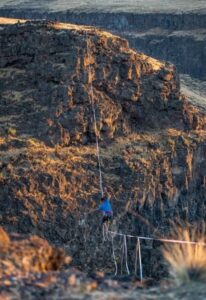
NAAA is aware of at least one ag operation that has successfully imported a file from slackmap.com to their pilot’s iPads. There may also be local slackline groups in your area that you can contact and establish communications with; Facebook has numerous slackline groups.
Key reminders involve looking for these warnings in flight planning, recognizing they appear as faint icons on digital maps, and understanding the need for heightened awareness in canyons or remote areas where lines are often set up, often marked by lights but still challenging to spot. Don’t rely solely on identifying traditional power line structures; slacklines are different and less visible.
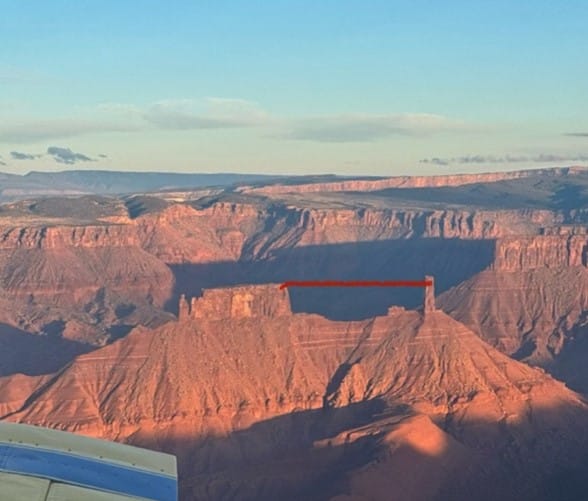
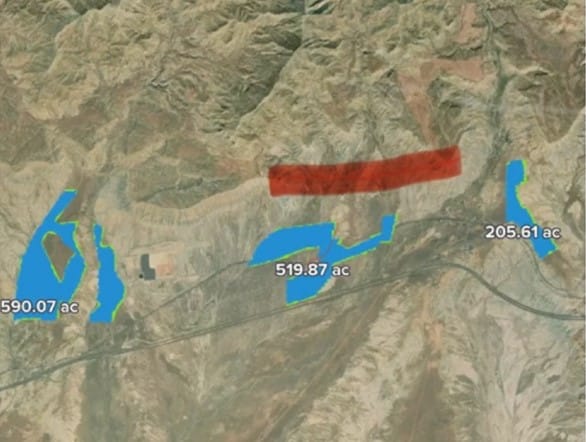
An ag aviator in Utah recently encountered a slackline in the area he was seeding. The slackline location in the photos (below) have been highlighted red to make its location visible.
Extra, Extra!! Winter 2026 Issue of Agricultural Aviation Now Online!
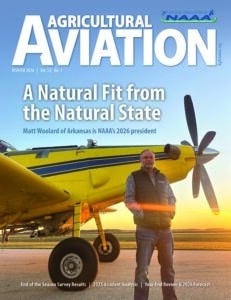
The Winter 2026 issue of Agricultural Aviation is available online and in the Agricultural Aviation Magazine App. Stories include introductions to the 2026 NAAA officer team, a policy review of 2025 and what’s in store for this year, results from the 2025 operator industry survey, a review of 2025 accidents and an article on the success of the Ag Aviation Expo.
Featured content in this issue includes:
- Matt Woolard of Arkansas is NAAA’s 2026 President
- Meet the 2026 NAAA Officers
- What Happened During NAAA’s 59th Year; and a Forecast of What’s Expected for the 60th Anniversary Year
- Ag Aviation Accidents – 2025 and 10-Year Trends
- 2025 Industry Survey Reported a Down Year for Agriculture, Including Its Air Force
- NAAA Ag Aviation Expo Resulted in Strong Connections & Record-Breaking Auction
- Happy 60th Birthday, NAAA! Honoring the Past & Celebrating the Journey of Aerial Application
- Celebrating Excellence: Meet the 2025 NAAA Award Recipients
Back issues are available in Agricultural Aviation’s Issue Library.
Get the free Agricultural Aviation App on your Apple, Google and Amazon mobile devices.
Back to top
Ag Aviation Showcased Whirlwind Aviation in Fisher, AR, with Digital Creator One-Legged Aviation
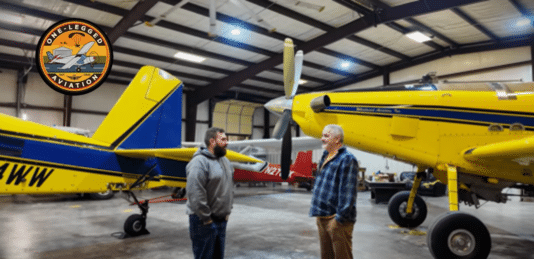
Recently, Brandon Vilt’s One-Legged Aviation YouTube channel spent time with NAAA member Rodney Shelley of Whirlwind Aviation in Fisher, AR, offering viewers an inside look at agricultural aviation. During the interview, Rodney walked Brandon through a true “day in the life” of an ag pilot, explaining how the aircraft operates, how aerial application works, and what goes into each day and each season. The discussion included an in-depth look at the cockpit, GPS use, spray system, along with a comparison of applying dry product with a spreader versus wet application.
One-Legged Aviation is the YouTube channel created by Brandon Vilt, a retired U.S. Army Master Sergeant, amputee, powered paragliding pilot, and self-described full-time aviation addict. Brandon uses the platform to sit down with pilots and share real aviation stories and detailed aircraft walkarounds bringing aviation to life for a wide audience.
NAAA Comments on UAAS Petition to Operate From Moving Vehicle
Last week, NAAA submitted comments on a petition from L&M Road Services LLC to amend their exemption to allow commercial Part 137 uncrewed aerial application system (UAAS) operations from a moving vehicle. While not explicit in the petition, NAAA’s interpretation of the intended operations is that of roadside right-of-way pesticide applications.
In an earlier request for information to the petitioner, FAA raised a multitude of concerns with operating UAAS from a moving vehicle. NAAA echoed several of these concerns through a lens of risk mitigation to crewed aerial application operations. With a dynamic operating environment, there is an increased risk to loss of visual line of sight (VLOS) when traveling through areas with trees, buildings and other obstacles. NAAA pointed out that the intended operations profile would abut numerous fields and other areas commonly trafficked by crewed aerial application aircraft.
Citing data from NASA’s Aviation Safety Reporting System (ASRS) and NAAA’s 2025 End of Season Operator Survey, the association expressed concern that, while the proposed UAAS operations would introduce crewed aerial applicators to additional exposure to the hazard of a midair collision with UAAS, no additional risk mitigations were proposed. Further, NAAA pointed to the reliance of pilots on identifying UAAS support trucks/trailers during reconnaissance to be aware of the presence of UAAS in the vicinity. As UAAS are nearly impossible to see in-flight, the proposed operations from a moving vehicle would eliminate this mechanism and further hinder the ability for crewed aircraft to avoid collisions with UAAS.
The remainder of the petition made several unfounded claims disparaging crewed aerial application operations. NAAA felt compelled to address these claims accordingly. You can read NAAA’s comments on this petition for the full details.
NAAA Comments on Petition for UAS Package Delivery Reporting Relief
On December 30, NAAA submitted comments on a petition for Zipline to make several amendments to their Part 135 UAS package delivery exemption. These amendments would collectively absolve the petitioner from having to submit service difficulty reports (SDRs), mechanical interruption summary reports, conduct pre-employment and random drug testing of its employees, conduct random alcohol testing of its employees and report pilot records to FAA’s Pilot Record Database.
NAAA’s comments centered on ensuring robust safety data reporting channels with FAA are maintained. While the petition made claims that some procedures were redundant by reporting similar information to multiple FAA offices, NAAA pointed to a recent DOT Office of Inspector General report which highlighted major deficiencies in interorganizational data visibility within FAA. Put simply, while data submissions may be duplicative to the petitioner, the separate recipient FAA offices independently rely upon those separate submissions.
More troublingly, the petition stated “in highly-autonomous operations, determining whether an interruption or diversion to a flight was the result of mechanical difficulties as opposed to a change in environmental conditions, avoidance of crewed aircraft, or other non-mechanical reason is not readily apparent and requires time-consuming review and analysis.”
NAAA expressed concerned with this rationale as a basis for the requested relief. While it may be inconvenient for the petitioner, it should remain incumbent upon them first and foremost to continue spending “time-consuming review and analysis” to identify whether interruptions/diversions are due to avoidance of crewed aircraft or mechanical/software malfunctions and report accordingly to FAA.
NAAA Comments on Petition for Uncrewed R22/R44 Part 137 Operations
On December 29, NAAA submitted comments on an exemption petition from Rotor Technologies to commercially operate the R220 and R550 uncrewed aerial application system (UAAS), with maximum takeoff weights of 1,360 lbs and 2,500 lbs respectively. The R220 is based on the Robinson R22 airframe and the R550 is based on the R44 airframe. The petitioner plans to manufacture new aircraft and offer retrofit conversions for existing R22 and R44 aircraft.
NAAA’s comments began with expressing concerns that these aircraft would not have an airworthiness certificate. The petition instead proposes to allow the pilot to make an airworthiness determination before each flight, in line with how all other uncrewed aircraft are treated in current exemptions. This would create a strange dichotomy wherein an R44 and R550 would be conducting materially similar operations with effectively similar airframes, yet be held to very different airworthiness standards.
Compounding this airworthiness concern is the petitioner’s request for relief from the §137.019(c) requirement of a Commercial Pilot Certificate to instead allow individuals holding a Remote Pilot Certificate with a Small UAS rating to act as pilot in command for Part 137 operations. While it is clear that these are not “Small UAS” by any definition, NAAA expressed concern that this would effectively vest in an individual with a (simply obtained) Remote Pilot Certificate the authority to determine the airworthiness status of an uncrewed R44.
Regarding maintenance, the petition requests that the R220 and R550 maintenance manuals be accepted in lieu of adherence to relevant regulatory requirements for maintenance, inspections and maintenance records. NAAA asserted that maintenance requirements, including maintenance personnel certification, should not be relaxed. In other words, an R550 and R44 should both be held to the same stringent maintenance and inspection standards to ensure the safety of other airspace users and the public.
Finally, since uncrewed aircraft are categorically prohibited from ADS-B Out, this petition requests relief from §91.225(h)(2) to allow operations with ADS-B Out in transmit mode. NAAA expressed full support for this provision in the interest of improving aircraft conspicuity to other aircraft pilots.
It will be of great interest if FAA and petitioner choose to pursue this Part 137 operational exemption or hold out for the yet to be finalized Part 108 regulatory framework. Regardless of the path taken, this does represent a significant juncture in aerial application operations; an uncrewed variant of a currently-in-use crewed aircraft. For this reason, it is also significant from a regulatory perspective; if you have two aircraft of the same weight, characteristics and capabilities except that one has a pilot on the ground rather than in the seat, how much do you relax regulatory oversight for the former?
NAAA & NAAREF Board Meetings Feb. 12-14 in Alexandria, VA, All Members Invited; PAC Breakfast Details
The February 2026 NAAA & NAAREF Board and Committee meetings will take place at the Hilton Old Town in Alexandria, VA. Click here to view a schedule of meetings. All meetings are open to NAAA members. If you are not a board or committee member but you’re interested in attending, please contact Lindsay Barber for more details.
Meeting Location
Hilton Old Town Alexandria
1767 King Street
Alexandria, VA 22314
- Rate: $172/night plus tax.
- Room Block Closes: January 20, 2026. Room rates will be higher after block closes, and we cannot guarantee rooms will be available after this date.
- Reservations:
- To book online: https://group.hilton.com/te94ah
- Call 1-800-HILTONS and refer to group/SRP code is 90O (that is 9 zero and the letter O)
- If you have hotel questions or issues, do not book outside the block. Please email Lindsay Barber your arrival and departure dates.
Board Books: All board books are provided electronically. Board and Committee members will receive a link and directions to download the electronic board book approximately one week before the meetings. The board book can be downloaded to your computer, tablet or you can print your committee items.
PAC Breakfast: Join us on Friday morning, Feb. 13th, at 7 a.m. at the Hilton Old Town for the AgAv PAC Breakfast. Congressman David Rouzer (R-NC) will speak. Register to attend here.
Back to top
Several AStar ADs Proposed For Revised Airworthiness Limitations
The FAA has proposed to supersede Airworthiness Directive (AD) 2023-01-04, which applies to various Airbus Helicopters AS350 and AS355 helicopters. AD 2023-01-04 requires, for helicopters with certain part-numbered tail rotor head spider pitch change units installed, inspecting the spider pitch change nut (nut) for correct installation; marking a 2 to 5 mm wide black paint index mark and repetitively inspecting the alignment of the marking; and performing additional inspections and corrective actions if necessary. Since the FAA issued AD 2023-01-04, the manufacturer revised the Airworthiness Limitation Section (ALS), which now includes the repetitive black index marking inspections. This proposed AD would require the same actions of AD 2023-01-04, except for the repetitive black paint index marking inspection (since this is now incorporated into the ALS) and would prohibit installing certain parts unless certain requirements are met. You can view this proposed AD here; comments are due February 2, 2026.
The FAA has proposed to supersede AD 2022-11-08, which applies to various AS350 helicopters. AD 2022-11-08 requires incorporating into maintenance records certain requirements (airworthiness limitations). Since the FAA issued AD 2022-11-08, it was determined that new or more restrictive airworthiness limitations are necessary. This proposed AD would require revising the ALS of the existing maintenance manual (MM) or instructions for continued airworthiness (ICAs) and the existing approved maintenance or inspection program, as applicable. You can view this proposed AD here; comments are due February 23, 2026.
The FAA has proposed to adopt a new AD for AS350B2 and AS350B3 helicopters. This proposed AD was prompted by a determination that new or more restrictive airworthiness limitations are necessary. This proposed AD would require revising the ALS of the existing MM or ICAs and the existing approved maintenance or inspection program. You can view this proposed AD here; comments are due February 23, 2026.
In Case You Missed the Last NAAA eNewsletter
Click here for the January 8, 2026 eNewsletter to read:
- NAAA Meets with FAA Administrator Bryan Bedford and Additional FAA Leadership to Discuss FAA UAS BVLOS Proposed Rule
- FCC Prohibits Foreign UAS Authorization; Existing Models Unaffected
- Start the Year with a New 2026 NAAA Membership!
- Top 10 Agricultural Aviation Articles of 2025
- Don’t PAASS Up Safety Education – Attend the 2025-2026 PAASS Program, Collect CEU’s, Qualify for C-PAASS and Fly Safe
- NAAA & NAAREF Board Meetings Feb. 12-14 in Alexandria, VA, All Members Invited