

Click on the article title below to be taken directly to the article. After you’re done reading the article, click “Back to Top” at the bottom to be brought back to the Table of Contents.
Table of Contents
- Supreme Court Rules Against Trump’s Use of Tariffs According to One Statute; He Counters Using Another Statute
- 15,000 on Facebook—NAAA Social Media Momentum Continues to Grow!
- FAA Renews Guidance for Operator Certification Process – NAAA Assistance Requested for Part 137
- What Do Paraquat, Atrazine, Chlorpyrifos, Tribufos, Endothall, Isocycloseram, Gamma-cyhalothrin and Rotenone All Have in Common?
- Nominations Open for the 2026 NAAA Awards
- FAA GA Survey Underway – Please Participate if You Receive Invitation
Supreme Court Rules Against Trump’s Use of Tariffs According to One Statute; He Counters Using Another Statute
Last week, in welcome news amongst most industry circles, particularly agricultural ones, the Supreme Court ruled in a 6-3 decision against President Trumps 10 percent tariff imposed last April on nearly every country in the world, as well as specific, higher tariffs on some of the top U.S. trading partners, including Canada, Mexico, China, the European Union, Japan and South Korea. “With supply costs already at or near record highs, we strongly encourage the president to avoid using any other available authorities to impose tariffs on agricultural inputs that would further increase costs,” American Farm Bureau Federation President Zippy Duvall said in a statement. The American Soybean Association (ASA), whose members were slammed last year by China’s monthslong boycott of U.S. soybeans, echoed Duvall’s plea. “The case at the Supreme Court has been closely followed by soybean farmers who have seen the cost of inputs rise over the past year due to tariffs,” ASA President Scott Metzger said in a statement. “Because farmers are caught in a cost-price squeeze and ag input costs remain high, we urge the President to refrain from imposing tariffs on agricultural inputs using other authorities.”
Unfortunately, Trump moved after the Supreme Court decision to impose a global tariff rate of 15 percent, invoking Section 122 of the Trade Act of 1974. That provision allows the president to impose tariffs of up to 15 percent for 150 days.
15,000 on Facebook—NAAA Social Media Momentum Continues to Grow!

Thanks to your support, NAAA has reached an exciting milestone — 15,000 followers on Facebook! Even more impressive, our audience has grown by 1,000 followers in a few short months, reflecting strong interest in the story of agricultural aviation.
If you haven’t already, be sure to follow the National Agricultural Aviation Association on Facebook and invite your friends and colleagues to do the same. You can also stay connected with NAAA on X (Twitter), Instagram and LinkedIn for updates on advocacy efforts, safety initiatives, events and industry news throughout the year. Also, share NAAA’s posts on social media to spread the positive messages of the aerial application industry so your followers can see them. Some of NAAA’s posts have been shared and shared to the point they have been seen on some occasions by hundreds of thousands of people!
Each new follower helps amplify the essential work ag pilots do to support farmers in producing a safe, affordable and abundant supply of food, fiber and bioenergy, while also protecting forestry and controlling health-threatening pests. When you like, share and comment on posts, you help extend that message far beyond our immediate membership.
Together, we can continue elevating the visibility and value of agricultural aviation.
FAA Renews Guidance for Operator Certification Process – NAAA Assistance Requested for Part 137
It is no secret that applicants for Part 137 Certification have been subject to long wait times for the processing of their application. This is, however, not unique to Part 137.
Until 2024, certification applicants were added to the Certification Services Oversight Process (CSOP) National Applicant List as soon as the FSDO received their application. In short, they were put in line to await available FAA personnel/resources to process their application.
In 2024, FAA issued Notice 8900.687, noting an increased trend of certification applicants who were not ready to begin the initial certification process, typically due to a lack of prerequisite paperwork. These unprepared applicants tied up FAA resources, slowing down the process for all. This Notice initiated a new process seeking to remedy the situation, which front-loads the applicant requirements to demonstrate readiness for certification before they are placed in line on the CSOP National Applicant List.
In an additional effort to alleviate FSDO personnel workload and reduce wait times for applicants, FAA has charged industry organizations and associations, including NAAA, with providing education to applicants on what is needed for a successful initial certification process.
NAAA, in response to Notice 8900.687 and the above charge, worked with FAA to develop and release a Starting a Part 137 Operation guide which serves this function and provides prospective operators with a more comprehensive overview of the Part 137 certification process. This guide also covers some of the murkier topics specific to Part 137, such as Chief Supervisor vs. Pilot-In-Command Knowledge & Skills and adding additional aircraft to an operator’s Letter of Authorization (LOA) A003.
Prospective and Current Part 137 operators will also be interested in the guide for its list of Part-137-specific titles of the Flight Standards Informational Management System (FSIMS), essentially the Aviation Safety Inspector’s handbook on certification, airworthiness, Knowledge & Skills and Surveillance. It can be quite handy, when in a debate with your FSDO over an issue, to point them to their own guidance for an answer.
FAA has reissued the guidance in Notice 8900.687 annually, with Notice 8900.728 in 2025 and most recently with Notice 8900.766 in 2026. It will continue to be re-issued annually until it is incorporated into FSIMS.
The Starting a Part 137 Operation guide can be found in the Career page of the NAAA website or directly linked here.
What Do Paraquat, Atrazine, Chlorpyrifos, Tribufos, Endothall, Isocycloseram, Gamma-cyhalothrin and Rotenone All Have in Common?
They are all pesticide active ingredients which faced complete or partial bans for aerial applications. The ability to continue to apply these products by aerial application was the result of efforts by NAAA. NAAA didn’t use special tactics or hire expensive lobbyists to accomplish this – we used industry data to show the economic importance and safety of aerial applications. That data came from you, and without fresh data NAAA may not be able to ensure you continue to have the ability to apply pesticides by air.
If you want to continue to apply pesticides with your agricultural aircraft, then you need to help yourself by completing the NAAA Industry Survey. If you are an ag pilot or operator, you should have received an email inviting you to participate. If you haven’t responded to that email, Kynetec (the ag research company contracted by NAAA to complete the survey) may be calling you now. Please answer the call or respond to the email.
The email will be coming from the email address [email protected] and the header will look like this:

If you still can’t find your email invitation, click the button below to email NAAA to make sure we have your correct email address.
Thank yourself for taking part in this critical industry survey because it’s your business or piloting job you’re protecting.
Nominations Open for the 2026 NAAA Awards

Do you have a rising pilot within your ranks? Do you admire certain NAAA members’ outstanding service to the industry or their community and believe they should be properly publicly recognized to serve as motivation for others? The aerial application industry is filled with exceptional people who go above and beyond the call of duty, often with little fanfare. Make someone’s day or year by nominating them for a 2026 NAAA Award.
NAAA’s online submission form is easy and quick to use; nominate someone in just a few clicks here.
There are eight NAAA Award categories and one NAAREF Award. While the nomination deadline is August 5, early submissions are recommended to avoid missing the deadline as the summer season kicks in.
NAAA Award Categories
- Agrinaut Award: Honors an agricultural aircraft operator, operating organization, or allied member company that has made an outstanding contribution in the field of ag aircraft operations. The achievement cited shall have contributed to the “state-of-the-art” for the benefit of the agricultural aircraft industry as a whole.
- Delta Air Lines “Puffer” Award: Recognizes an individual who has made an outstanding contribution to the design of agricultural aircraft and/or related equipment.
- Evans-Christopher Operation S.A.F.E. Award: Recognizes individuals or entities that have made outstanding contributions to the Operation S.A.F.E. program. (Presented by NAAREF.)
- John Robert Horne Memorial Award: Honors a pilot with five or fewer years of experience in the agricultural aviation industry who has an exemplary safety record and has contributed to safety in ag aviation. This award no longer has carryover nominations from year to year; a new nomination must be submitted every year.
- Larsen-Miller Community Service Award: Recognizes outstanding contributions by a member to his or her community.
- Opal and Bill Binnion Memorial Award: Acknowledges those who contribute to NAAA in its efforts to educate the public about aerial application.
- Richard “Dick” Reade Allied Memorial Award: Presented to an NAAA members or staff and/or an allied industry individual who has significantly contributed their efforts for the benefit of the allied industry and the aerial application industry.
- William O. Marsh Safety Award: Recognizes significant achievements in safety, safety education or an outstanding operational safety program.
- Zoren and Joan O’Brien Memorial Outstanding Service Award: Awards outstanding service to the commercial agricultural aviation industry or to its association.
The 2026 NAAA Award recipients will be honored at the Excellence in Ag Aviation Banquet on Nov. 18 in Savannah, GA.
FAA GA Survey Underway – Please Participate if You Receive Invitation
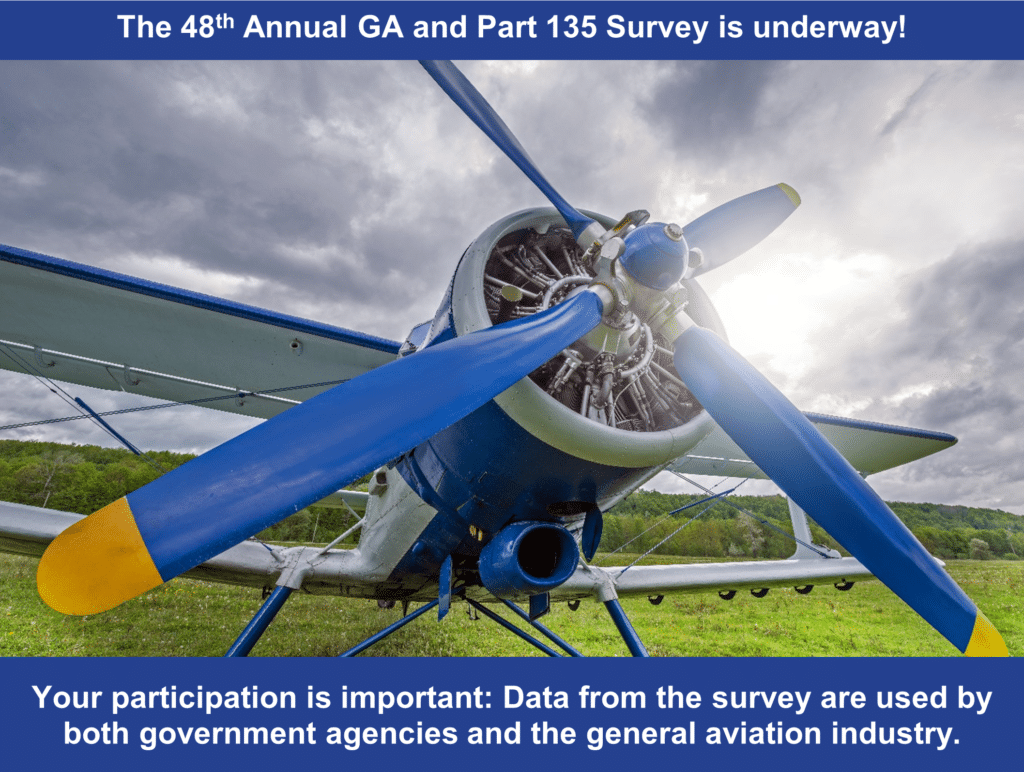
The Federal Aviation Administration’s annual General Aviation and Part 135 Activity Survey (GA Survey) is now underway, reporting on calendar year 2025. The GA Survey is the only source of information on the general aviation fleet and the number of hours flown. The GA survey is different than the Industry Survey being conducted by NAAA (see article in this eNewsletter) – participation in both is critical to documenting the importance and safety of ag aviation.
Data from the GA survey are used by governmental agencies and industry to
- compute safety metrics, such as fatal accident rates;
- understand the impact of the GA industry on jobs, economic output, and investments in aviation infrastructure;
- track the success of safety initiatives, including avionics recommendations;
- determine funding for infrastructure and service needs; and
- assess the impact of regulatory changes.
The FAA and the ag aviation industry need accurate data on a broad range of aircraft. Your participation is voluntary, but we need your help. We encourage everyone who is contacted to respond to the survey so that all aviation activity is represented. The intitial inviations will be sent to owners/operators of single aircraft. An invitation for an abvreviated form for owners/operators of multiple aircraft will be sent later this month.
GA and Part 135 Activity Survey Basics
To provide more information about the survey, Tetra Tech, the independent research firm that has been conducting an annual survey for the FAA for 26 years, compiled this FAQ list.
Q: Are responses confidential?
Yes, the information will only be used for statistical purposes and will not be published or released in any form that would reveal an individual participant. Individually identifiable responses are never shared — not with the FAA, other government agencies, or any other organization.
Q: How are participants contacted?
Participants who are selected will receive an email or postcard invitation asking them to complete the survey online. Those who do not complete the survey online will receive a mail survey, which includes a postage-paid return envelope.
Q: Is it easy to complete the survey?
Yes! It only takes 10-15 minutes to complete the survey, which you can do online or on a survey form that will be mailed to you, along with a postage-paid return envelope. Or call Tetra Tech toll-free at 1-800-826-1797.
Q: I didn’t fly my aircraft in 2025. Do I still need to complete the survey?
Yes, please respond even if you did not fly your aircraft during 2025, sold it, or if theaircraft was damaged.
Q. Will I receive a survey form for each aircraft I own?
An abbreviated survey form is available for owners/operators of three or more aircraft. To obtain one, contact Tetra Tech toll-free at 1-800-826-1797 or email [email protected].
Q. I did this last year. Why am I receiving the survey again?
Several groups of aircraft are surveyed every year to better understand the aviation activity of high-use groups, such as turbine aircraft, rotorcraft, newer aircraft, and Alaska-based aircraft.
Q. Who should I contact if I have more questions?
Please contact Tetra Tech toll-free at 1-800-826-1797 or email [email protected].
Q: How many aircraft are sampled annually?
More than 80,000, or about 30 percent of the population, but the sample includes smaller proportions of some aircraft. Participation across all types of aircraft is critical to success!
Q: Where can I find survey results from previous years?
Visit here.
In Case You Missed the Last NAAA eNewsletter
Click here to read the February 20, 2026 eNewsletter:
- A Full Aerial Application Agenda in Our Nation’s Capital Area Occurred Last Week as NAAA, NAAREF and Leadership Training for Tomorrow’s Industry Leaders Took Place
- FAA Implements Special Emphasis Enforcement Program for UAS Operations
- FAA’s FAASTeam Webinar on Drone Registration Scheduled for February 24 at 19:00 CST—Registration is Required for Drones Used in Section 44807 Exemptions and Part 137 Operations
- NAAA Leadership Programs Prepare Industry Advocates in Washington, DC
- Ag Aviation Industry Needs Your Information – Please Participate in NAAA Industry Survey, Coming to Your In-Box from [email protected]
- AD Proposed for Bell 407 Instrument Panel Electrical Harness Chafing