

Click on the article title below to be taken directly to the article. After you’re done reading the article, click “Back to Top” at the bottom to be brought back to the Table of Contents.
Table of Contents
- Farmers’ Perceptions of Agricultural Drones Presented at the Ag Aviation Expo
- EPA Proposed Rule Defining Waters of the U.S. (WOTUS) Confines Regulatory Reach as Dictated by Supreme Court
- How Would You Rate the 2025 NAAA Ag Aviation Expo? Please Tell Us by Dec. 5!
- Reno Reflections: Photo Highlights From the 2025 Expo, Check ‘em Out
- Give Back! Support NAAREF Today
- DynaNav and Microair Avionics Announce New Integrated Digital Air-Data Solution for Agricultural Aviation
- Superseding AD Proposed for AStar MGB Particle Inspections
Farmers’ Perceptions of Agricultural Drones Presented at the Ag Aviation Expo

At the Ag Aviation Expo in Reno last month, Jay Vroom, former President and CEO of CropLife America, and currently a strategic advisor with DCLRS consulting, presented on farmers’ perceptions of agricultural spraying drones. The study highlighted findings from a Stratovation Group research study in partnership with the Ag Retailers Association, The Fertilizer Institute, D.C. Legislative and Regulatory Services (DCLRS) and CropLife America. In addition, the study was sponsored by SweetWater Technologies, the National Corn Growers Association, AgriSpray Drones and Syngenta.
Vroom presented the results of the 2025 survey examining how both drone users and non-users view drones for applications. The survey was completed by 261 large, full-time row crop farmers across the U.S. Of the 261, 101 currently use a drone, while the remaining 160 do not use a drone.
When asked when they plan to purchase a new drone, 53% of current drone users said they would acquire one within the next 35 months. Of those growers using drones, 28% indicated they do not plan on purchasing another drone in the future. From the pool of growers who do not currently use drones, 30% plan on adding a drone to their farming operation within the next 35 months, while 41% do not plan on ever adding a drone to their farm.
Current drone users have a very positive impression of drones – the response asking them to rate their perception of drones on a scale of 1 (very negative) to 10 (very positive) yielded an average rating of 7.99. DJI was the most commonly used brand of drones and the most recognized. When asked to provide the benefits sought by using drones, both drone users and non-users agreed on the following as the top benefits of drones:
- Access to difficult terrain/topography
- Timely in-season application
- Improved spray efficiency
- Enhanced crop monitoring
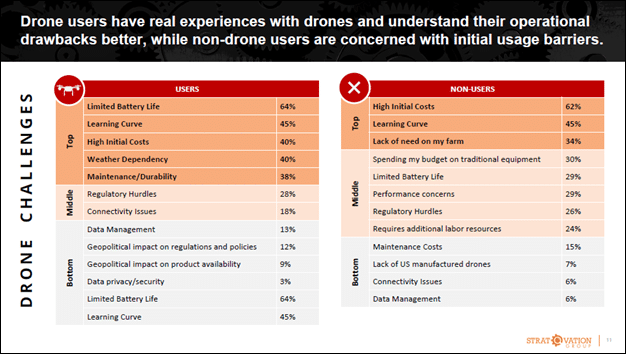
When asked about the challenges associated with using drones on their farm, the top concerns from growers who are already using drones are:
- Limited battery life
- Learning curve
- High initial costs
- Weather dependency
- Maintenance/durability
Growers who do not use drones also had concerns about the initial costs and learning curve, as well as the lack of need for a drone on their farm.
EPA Proposed Rule Defining Waters of the U.S. (WOTUS) Confines Regulatory Reach as Dictated by Supreme Court
EPA released a proposal to update the definition of Waters of the United States (WOTUS) last month in an attempt to resolve years of regulatory uncertainty and attempts to align federal jurisdiction with the Supreme Court’s 2023 Sackett decision. Sackett explicitly held that “the CWA extends to only those wetlands that are `as a practical matter indistinguishable from waters of the United States.’” The Court stated that this test “requires the party asserting jurisdiction over adjacent wetlands to establish `first, that the adjacent [body of water constitutes] . . . water[s] of the United States,’” (i.e., a relatively permanent body of water connected to traditional interstate navigable waters); and second, that the wetland has a continuous surface connection with that water, making it difficult to determine where the “water” ends and the “wetland” begins.
The proposal also attempts to reduce regulatory burdens and associated costs with compliance. To achieve these aims, EPA proposes narrowing the scope of jurisdiction to relatively permanent waters and wetlands that maintain a continuous surface connection to such waters. The rule also refines key terms, including “relatively permanent” and “tributary,” and clarifies long-debated exclusions for features such as certain ditches, prior converted cropland, waste treatment systems, and groundwater. EPA maintains that these updates directly address longstanding stakeholder requests for clearer, more predictable standards that lessen compliance uncertainty and litigation risk. The agency defines “relatively permanent” to mean “standing or continuously flowing bodies of surface water that are standing or continuously flowing year-round or at least during the wet season.” The agency defines “tributary” to mean “a body of water with relatively permanent flow, and a bed and bank, that connects to a downstream traditional navigable water or the territorial seas, either directly or through one or more waters or features that convey relatively permanent flow.” Further, the proposed definition of “tributary” clarifies that a “tributary does not include a body of water that contributes surface water flow to a downstream jurisdictional water through a feature such as a channelized non-jurisdictional surface water feature, subterranean river, culvert, dam, tunnel, or similar artificial feature, or through a debris pile, boulder field, wetland, or similar natural feature, if such feature does not convey relatively permanent flow.
EPA also underscored the rule’s economic implications, noting that improved regulatory clarity stands to benefit farmers, ranchers, and developers who rely on consistent water-related permitting frameworks. The full proposal is available in the Federal Register, with a 45-day public comment period, due January 5, 2026. Given how frequently WOTUS has shifted across administrations, many view this proposal as the closest attempt yet at establishing a durable, commonsense framework. The proposal, if made permanent and remains unchanged by subsequent administrations, will reduce the areas required to obtain a pesticide general permit under the Clean Water Act’s National Pollutant Discharge Elimination System (NPDES), which has been a burden to aerial applicators making pesticide applications over or near these waters since EPA promulgated the rule in 2011.
Back to top
How Would You Rate the 2025 NAAA Ag Aviation Expo? Please Tell Us by Dec. 5!
Thank you to the attendees and exhibitors for joining us at the 2025 NAAA Ag Aviation Expo in Reno last month. We continually work to improve our education sessions, networking, trade show and the programs/services offered to attendees. Click the link below to complete the short survey so that we have substantive input to help us continue to improve future Ag Aviation Expo. Please complete the survey by Dec. 5.
All responses are anonymous, but if you wish to share further details, please contact Lindsay Barber, NAAA’s Director of Communications & Meetings. Thank you for taking the time out of your schedule to complete this important survey. We look forward to seeing you Nov. 16-18, 2026, in Savannah, Georgia.
Back to top
Reno Reflections: Photo Highlights From the 2025 Expo, Check ‘em Out
Photos from the 2025 Ag Aviation Expo in Reno, Nevada, are available now! The event offered a tremendous opportunity for ag aviation professionals to connect with peers, mentors, and industry leaders. This year, we had a local photographer onsite throughout the four-day event, capturing hundreds of high-quality images.
In addition to documenting the NAAREF Casino Night Fundraiser, General Session, keynote speakers Ray Starling and Allan Gray, the live auction, and Excellence in Ag Aviation Banquet, he also photographed the Exhibit Hall and education sessions addressing current issues facing the industry, and the many networking opportunities throughout the week.
Photos are organized by day and are now available to browse and order through the online links here: Sunday, Monday, Tuesday, Wednesday.
Back to top
Give Back! Support NAAREF Today

As the year draws to a close, we invite you to consider a donation to the professional and life-saving mission of the National Agricultural Aviation Research & Education Foundation (NAAREF). Your support directly funds vital programs such as PAASS, Operation S.A.F.E. and other invaluable industry education programs. NAAREF programs were designed and are succeeding in promoting safety and environmental professionalism to the aerial application industry. Without successful NAAREF educational programs, it’s unquestionable that the regulatory requirements facing us would be more rigorous.
NAAREF programs save lives, enhance our industry’s reputation, enable insurance discounts, and help us meet regulatory requirements for certification. Since it first hit the stage in 1998, PAASS—the Professional Aerial Applicators’ Support System—has reduced our accidents and drift complaints by 26%. This is a phenomenal achievement and PAASS played a major role. Presently, NAAREF has taken on another crucial project to aide the industry—updating the aerial drift model known as AGDISP. This endeavor will ultimately result in applicators using tested aerial drift reduction technologies and techniques to be rewarded with more pesticide label flexibility.
To continue NAAREF’s vital mission, it takes industry donations from individuals such as yourself to ensure top quality and effective NAAREF programs. You can make a tax-deductible donation to NAAREF here.
Did you know that you can also make a donation directly from your retirement account to NAAREF? When you reach age 73*, you’re required to withdraw a certain amount of money from your retirement accounts each year. Talk to your tax advisor for the most up-to-date information regarding a required minimum distribution (RMD) that you can donate to NAAREF. The RMD is an attractive way for donors to make a significant charitable gift directly from their IRA to a charity through a qualified charitable contribution (QCD) while avoiding taxable income. QCD is a direct transfer of funds from your IRA payable to a qualified charity, such as NAAREF. You can also bequeath charitable funds to NAAREF through your will or trust. Please talk to your financial advisor and/or legal consultant about these options.
With government support no longer available, we have lost 14% of the revenue needed to offer NAAREF programs. Pesticide manufacturing companies’ consolidation has also resulted in a loss of NAAREF sponsorship revenue. We need to increase the amount of charitable donations from individuals and companies such as yourself in order to make up for the loss and to not suffer a reduction in quality of PAASS.
Please donate now to help support NAAREF programs and cultivate education, safety, and technology advancements in the industry. They save lives, reduce drift incidents, demonstrate the professionalism of the aerial application industry, and can help stave off additional government regulations.
**Beginning in 2023, the SECURE 2.0 Act raised the age that you must begin taking RMDs to age 73.
Last month, DynaNav Systems and Microair Avionics announced a new solution designed specifically for agricultural aviation pilots. This collaboration brings DynaNav’s aerial application technologies to the cockpit, paired with Microair’s advanced T3000 Digital Pitot Static and Angle-of-Attack (AoA) Probe System, to deliver a new level of precision, situational awareness and safety to ag-aviation operators.
By combining real-time wind awareness with digital air-data and AoA sensing, it provides ag pilots with clearer insight into changing conditions during low-level, high-load operations. The system provides real-time wind speed, direction, and angle-of-attack awareness, allowing pilots to visualize wind relative to their aircraft’s heading and spray path, helping improve application precision and reduce overspray when working around sensitive crops.
“At DynaNav, our focus is delivering tools that improve accuracy and efficiency in aerial application,” said Reg Moen, President, DynaNav Systems Inc. “Working with Microair allows us to add a level of wind intelligence that further supports pilots’ application precision, whilst also enhancing safety.”
The Microair T3000PSP system features a fully digital, compact design with no external plumbing, triple-redundant internal sensing, and an installation kit that makes installation easy. Its rugged construction and minimal installation footprint make it ideal for agricultural airframes that require robust, dependable equipment. Learn more at https://dynanav.com/ and www.microair.aero.
Superseding AD Proposed for AStar MGB Particle Inspections
The FAA has proposed to supersede Airworthiness Directive (AD) 2025-06-04, issued in April 2025, which applies to certain Airbus Helicopters Model AS350 and AS355 helicopters. As NAAA previously reported, AD 2025-06-04 requires repetitively inspecting the main gearbox (MGB) bevel wheel and the MGB magnetic plug for particles and performing corrective actions if applicable and prohibits installing an affected MGB unless certain requirements are met.
Since AD 2025-06-04 was issued, the FAA determined that it contains errors in the interval compliance times. Specifically, the interval compliance time should be 100 hours time-in-service (TIS) instead of 30 hours TIS. This proposed AD would continue to require the actions of AD 2025-06-04 and revise the interval compliance time.
You can view the proposed AD here. Comments are due January 9, 2026.
In Case You Missed Last Week’s NAAA eNewsletter
Click here for the November 26, 2025 eNewsletter to read:
- NAAA Ag Aviation Expo Resulted in Strong Connections & Record-Breaking Auction
- RTX’s Pratt & Whitney Canada PT6A Engine Surpasses One Million Flight Hours in 2025
- AD Proposed for Pawnee Wing Spar Cracks and Corrosion – Your Feedback Requested
- Superseding AD Proposed for MD 369/500 Torque Tube
- AD Proposed for Bell 407 Pilot Cyclic Stick Tube
- AD Proposed for AStar Cargo Hooks