

Click on the article title below to be taken directly to the article. After you’re done reading the article, click “Back to Top” at the bottom to be brought back to the Table of Contents.
Table of Contents
- NAAA Ag Aviation Expo Resulted in Strong Connections & Record-Breaking Auction
- RTX’s Pratt & Whitney Canada PT6A Engine Surpasses One Million Flight Hours in 2025
- AD Proposed for Pawnee Wing Spar Cracks and Corrosion – Your Feedback Requested
- Superseding AD Proposed for MD 369/500 Torque Tube
- AD Proposed for Bell 407 Pilot Cyclic Stick Tube
- AD Proposed for AStar Cargo Hooks
NAAA Ag Aviation Expo Resulted in Strong Connections & Record-Breaking Auction
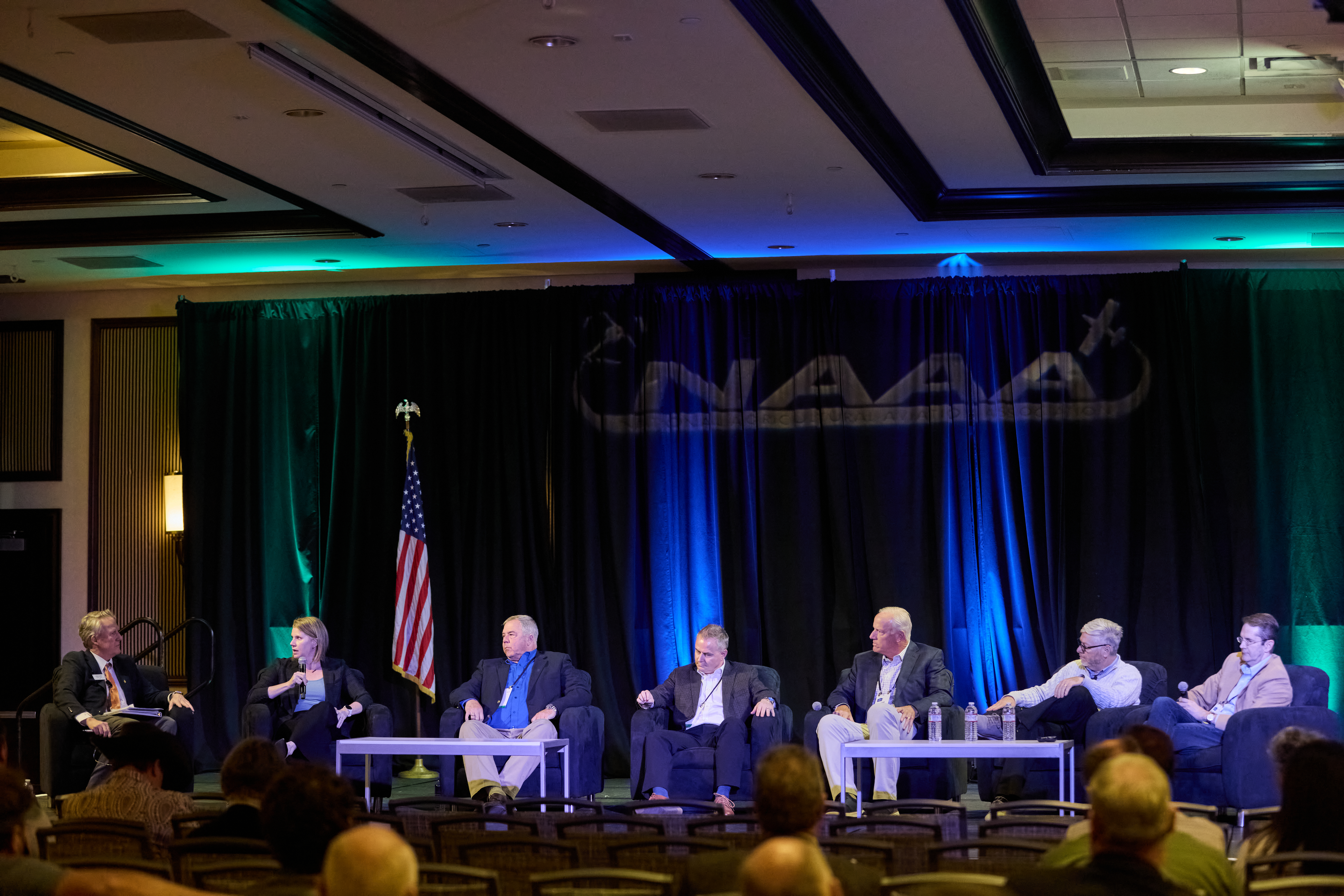
As we reflect on this year’s annual convention in Reno, we are grateful for the incredible energy and engagement from all who attended. While our crowd was smaller than in previous years, the atmosphere was full of energy, and there were meaningful connections between attendees, exhibitors and presenters. Participants were deeply engaged, education sessions were full, and networking was happening around every corner, offering valuable opportunities for connection. A highlight of the event was our record-breaking live auction, made possible by the generosity of our auction donors and the enthusiastic support of our winning bidders. Thank you to all who contributed to making this convention a success, even in the face of unexpected challenges, including government shutdown-related travel restrictions leading up to the event.
Held at the Reno-Sparks Convention Center and Atlantis, the event drew around 1,000 attendees and 139 exhibitors. This year’s exhibit hall featured two Air Tractors, an Ag Cat exhibited by Turbine Conversions, a gyroplane exhibited by AG-NAV, and a Gamebird from Game Aerospace. Thrush also had an aircraft in Reno and transported attendees to the airport throughout the event to view their Thrush 510. The exhibit hall aisles included high-tech displays, product demonstrations and opportunities for exhibitors to connect with prospective customers.
Beyond the exhibit hall, the convention featured a packed schedule of sessions and networking events to foster learning, knowledge exchange and CEUs. The convention kicked off with a full day of safety sessions, and 115 operators and pilots heard from Utilities/Aviation Specialists Inc. on flying in the wire-and-obstruction environment, followed by a four-hour flying an ag plane safely course taught by Fran de Kock of Battleford’s Airspray.
Attendees were treated to a stellar lineup of keynote speakers, including Kickoff Breakfast speaker Ray Starling, economist Allan Gray, and a panel of leading industry experts discussing the consumers attitude toward agriculture, the economic state of agriculture and its effects on the aerial application industry. There were also numerous concurrent sessions covering a wide range of topics, including airframe, helicopter, engine, and pesticide updates, as well as news and training from Allied members. New and low-time pilot sessions were packed full of aerial application newbies who made connections and learned from veteran operators, pilots and industry insurance representatives.
The 2025 Live and Silent Auctions raised a record-breaking amount of vital funds to support NAAA programs and services. The association is thankful to all companies and individuals who support NAAA programs by donating auction items and winning bidders. A special thank you to Pratt & Whitney Canada for donating a brand-new PT6A-34AG engine and to Air Tractor for their custom golf cart, along with many other generous donations. Congratulations to Logan Lane of Lane Aviation in Rosenberg, Texas, for being the highest bidder on the Pratt & Whitney Canada engine.
NAAA was honored to have 45 companies sponsor different events, and we are very appreciative of their support. Thank you to all sponsors, including the Diamond sponsors: BASF, Pratt & Whitney Canada, Syngenta, the Tylor Johnson Legacy Foundation and UPL.
The upcoming Winter 2026 Agricultural Aviation magazine will feature a detailed review of the Ag Aviation Expo; watch your mailboxes in January for that issue, including profiles on the recipients of the Excellence in Ag Aviation Banquet awards for their remarkable service to the industry. Save the date for the 2026 Ag Aviation Expo, taking place November 16-18, 2026, in Savannah, Georgia.




RTX’s Pratt & Whitney Canada PT6A Engine Surpasses One Million Flight Hours in 2025
At last week’s NAAA Ag Aviation Expo in Reno, Nevada, it was announced that the global fleet of Pratt & Whitney Canada PT6A turboprop engines, designed specifically for agricultural aviation and firefighting missions, had flown more than one million hours this year. Since the first PT6A engine model for the aerial application industry was certified in 1977, Pratt & Whitney Canada has developed eight different models, with close to 5,000 engines produced to date. Pratt & Whitney is an RTX business.
The eight PT6A engine models power aircraft manufactured by Air Tractor and Thrush Aircraft. These single-engine aircraft are used around the world to support a safe, affordable, and abundant food supply, control health-threatening pests, promote healthy forests, and fight forest fires.
“Pratt & Whitney Canada has long supported the aerial application industry and the critical missions it serves,” said Cedric Gauthier, vice president, Sales and Marketing, General Aviation, Pratt & Whitney Canada. “For nearly 50 years, we have worked in lockstep with airframers, maintainers, aircraft owners and pilots as they pursue missions that help feed the world and protect property from the ever-increasing threat of forest fires. Surpassing more than one million hours of flight this year speaks to the unique attributes of the PT6A engine, including its performance, innovation and reliability.”
The PT6 engine family remains the benchmark in general aviation, having powered more than 155 different aircraft types and amassing over 500 million flying hours since its introduction in 1963. Today’s PT6 engines are up to four times more powerful than the original model, with a 50% improved power-to-weight ratio and up to 20% better specific fuel consumption.
AD Proposed for Pawnee Wing Spar Cracks and Corrosion – Your Feedback Requested
The FAA has proposed adopting a new airworthiness directive (AD) for all LAVIA ARGENTINA S.A. (LAVIASA) Model PA-25, PA-25-235, and PA-25-260 airplanes. LAVIASA is the current holder of the Type Certificate for all PA-25 variants which was previously held by Piper. This proposed AD applies to all serial numbers and thus affects all PA-25 models produced by Piper as well.
In December 2024, Argentina’s equivalent to the FAA issued an airworthiness directive (ANAC Argentina AD 2024-05-01 R1) in response to reports of corrosion found in the front and rear wing spars and cracks found in the front wing spar. In addition, cracks were found in holes that were drilled to fix the leading edges, which could propagate towards the spar web.
The Argentina AD requires doing repetitive inspections of the front and rear wing spars for corrosion and crack(s) and the front wing spar for alteration(s) (change of leading edge, repairs, non-approved perforations) and crack(s); repairing or replacing front and rear wing spars if crack(s), corrosion, or alteration(s) are found.
LAVIASA Service Bulletin No. 25-57-09, REV 0, dated November 27, 2023, specifies procedures for inspecting the lower wing surface for inspection covers and installing inspection holes and covers as applicable, inspecting the forward and aft wing spars for corrosion and crack(s), and ensuring the drain holes are in the correct position and free from any obstruction(s).
LAVIASA Service Bulletin No. 25-57-11, Rev 00, dated August 23, 2024, specifies procedures for installing rectangular inspection doors near the forward wing spar, verifying the location of the screws on the upper and lower T flanges, inspecting to determine if there are more than four holes between ribs on the leading edge tabs, inspecting for crack(s) near the bore holes, doing a borescope inspection of inside surface of the T-flange for crack(s) and if any crack(s) are found uncovering the complete wing and doing a detailed inspection of the wing spar.
FAA’s proposed AD would require compliance with the above Service Bulletins. The initial compliance time is based on spar time, whether/when spars have been replaced, and whether/when alterations have been made to the spars. Thereafter, every 100 hours time-in-service, inspect the lower wing surface for inspection covers and install inspection holes and covers as applicable, inspect the front and rear wing spars for corrosion and crack(s), and ensure the drain holes are in the correct position and free from any obstruction(s). In addition, inspect the upper/lower spar flange of the front wing spar for any crack(s), evidence of overlapping, enlarged holes, or more than four holes found, and at least two of them are less than one inch away from each other, paying particular attention to the leading-edge fitting area. Any cracks or corrosion found will require spar replacement.
You can view the proposed AD and submit comments here. Comments are due January 2, 2026.
If your operation would be impacted by this AD as proposed, and you have data/information which would contradict the applicability and/or required actions within it, please contact Matt Gill at NAAA.
Superseding AD Proposed for MD 369/500 Torque Tube
The FAA issued AD 2024-23-06 in November 2024 for certain MD Helicopters Model 369, 500N, and 600N helicopters with a pilot interconnecting cyclic torque tube (torque tube) part number 369H7133-7 installed. AD 2024-23-06 was prompted by a report of a seized and damaged roller bearing assembly in the torque tube assembly of an MD369E helicopter. This damage did not allow the torque tube to rotate as designed, which initiated a crack and resulted in an emergency landing. The seized roller bearings were due to rust compounded with dried grease residue and an aggressive chemical environment. Because the seized roller bearings did not allow the torque tube to rotate freely, additional torsional stresses occurred on the torque tube, which caused a crack to initiate and eventually propagate until the part failed and longitudinal control was lost. AD 2024-23-06 requires repetitive visual inspections of the torque tube for corrosion and cracks, repetitive visual inspections of the roller bearings for corrosion and degradation, a repetitive freedom-of-movement inspection of the torque tube assembly for binding or ratcheting, and corrective or additional action as necessary.
Since AD 2024-23-06 was issued, the FAA received a report that additional torque tube assemblies are affected by this unsafe condition and should be included in the AD action. Due to this determination, this proposed AD would expand the applicability to include all MD Helicopters, LLC Model 369, 369A, 369D, 369E, 369F, 369FF, 369H, 369HE, 369HM, 369HS, 500N, and 600N helicopters regardless of the torque tube part number.
You can view the proposed superseding AD here. Comments are due January 2, 2026.
AD Proposed for Bell 407 Pilot Cyclic Stick Tube
The FAA has proposed to adopt a new airworthiness directive (AD) for certain Bell Textron Canada Limited (Bell) Model 407 helicopters. This proposed AD was prompted by a report of a fractured pilot cyclic stick tube and subsequent findings of other pilot cyclic stick tubes with fatigue cracking. This proposed AD would require repetitively inspecting the pilot cyclic stick tube assembly for a crack and, depending on the results, repairing or replacing the pilot cyclic stick tube assembly.
Transport Canada has issued AD CF-2024-18, dated May 29, 2024, to correct an unsafe condition on Bell Model 407 helicopters with a pilot cyclic stick tube assembly part number (P/N) 206-001-342-101 or 206-001-342-101FM installed. Bell received a report that a pilot cyclic stick tube assembly fractured at the lower end of the tube near the upper slotted area where it is held in place in the pivot assembly. Examination of the fractured pilot cyclic stick tube and subsequent findings of other cracked pilot cyclic stick tubes revealed fatigue cracking. Further investigation identified the root cause of the pilot cyclic stick tube cracking as the application of excessive force to the cyclic stick during the freedom of movement of the controls and cyclic centering light operation check as part of the interior and prestart check, which resulted in elevated stress at the slotted area and was aggravated by the high stress concentration design feature of the upper slotted area.
This proposed AD would apply to all Bell 407 helicopters with affected cyclic stick tube assembly P/Ns installed, and would require accomplishing some of the actions specified in Transport Canada AD CF-2024-18 and Bell ASB 407-23-130, Revision A, dated 27 March 2023. In addition, for pilot cyclic stick tube assemblies that have accumulated 3,600 or more hours time-in-service, even if no cracks are identified on an initial inspection, repetitive detailed inspections at intervals not to exceed 300 hours time-in-service will be required.
You can view the proposed AD here. Comments are due January 2, 2026.
AD Proposed for AStar Cargo Hooks
The FAA has proposed to adopt a new airworthiness directive (AD) for all Airbus Helicopters Model AS-350 helicopters. This proposed AD was prompted by a report of non-conformity of a certain cargo hook. This proposed AD would require inspecting the gap between the filler and the side plates of the affected cargo hook and, depending on the results, replacing the cargo hook. This proposed AD would also prohibit installing an affected cargo hook on any helicopter. The FAA is proposing this AD to address the unsafe condition on these products.
The European Union Aviation Safety Agency issued EASA AD 2025-0036 on February 12, 2025, which specifies procedures for inspecting certain cargo hooks to measure the gap between the filler and the front and rear side plate assemblies and, depending on the results, replacing the cargo hook with a cargo hook that is not affected.
FAA’s proposed AD would require accomplishing the actions specified in the EASA AD.
You can view the proposed AD here. Comments are due January 2, 2026.
In Case You Missed Last Week’s NAAA eNewsletter
Click here for the November 13, 2025 eNewsletter to read:
- Federal Legislation Reopening U.S. Government Enacted; Includes Language Supporting USDA Aerial Application Research
- USAIG Adds Ag Pilot Simulator Training to its Performance Vector Benefits Program
- Top 10 Tips for Success at the NAAA Ag Aviation Expo
- Bid on Great Auction Items at NAAA Live Auction on November 18; Letter of Credit Required for PT6A-34AG Engine
- Beware of Fraudulent Scam Callers Using NAAA Name to Obtain Funds
- The New NAAA 365 App Puts Industry Resources at Your Fingertips