

NAAA Issues Press Release Urging Drone Operators to Prioritize Safety and Yield to Manned Agricultural Aircraft This Growing Season
With another growing season approaching and at a time when aerial application services are expected to be in high demand, NAAA sent a news release today advising uncrewed aircraft system (UAS) operators to be mindful of low-flying manned agricultural aircraft operations. The news release was distributed to trade media outlets covering agriculture, aviation and drones.
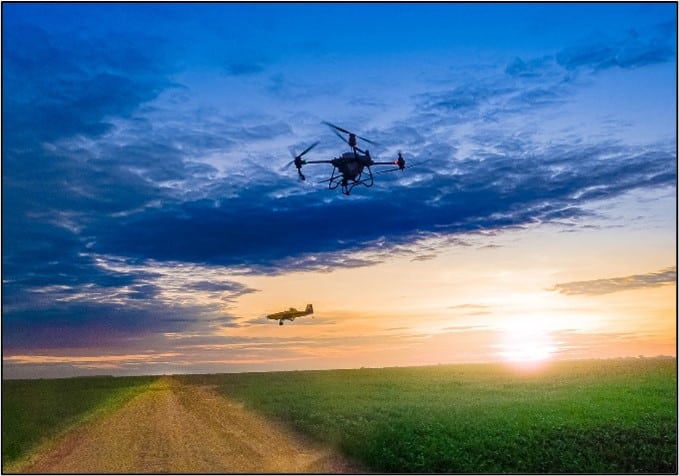
NAAA urges crewed and uncrewed aircraft to do everything possible to avoid possible collisions when conducting important low-altitude work, including the following recommendations:
- Uncrewed/drone aircraft give the right of way to a manned/crewed aircraft. It’s the law.
- When a crewed aircraft approaches its target field to apply, it should scout the field at altitude each time, even when making reloading returns, so as to provide uncrewed aircraft time to notice and land.
- Drones should equip with visible strobe lights, highly visible markings and tracking technology, like an ADS-B In system.
- Monitor aviation radio frequency 122.925 MHz for crewed agricultural aircraft. For uncrewed to transmit, consider obtaining a radio station license by submitting FCC Form 605.
- All aerial application services must be certified and well-trained in operating an uncrewed aircraft.
- Contact local agricultural aviation operations before flying by consulting the Find An Aerial Applicator database at AgAviation.org.
- Uncrewed aircraft should land immediately when a low-flying aircraft is nearby.
- All aerial application services must carry uncrewed aircraft liability insurance.
Research has proven that small UAS can be virtually invisible to agricultural aviators, air ambulance helicopters, law enforcement and other low-flying manned aircraft operating in the same airspace. For example, in January, a civilian drone collided with a CL-415 firefighting aircraft fighting the Palisades Fire in California, resulting in the specially designed firefighting plane sustaining wing damage and grounding the aircraft.
“With the increasing number of uncrewed aircraft operations over the last few years, their operators must be aware of low-flying, manned agricultural aircraft,” said Andrew Moore, chief executive officer of NAAA. “It is extremely difficult, if not impossible, for manned aircraft to see a drone while conducting aerial applications 10 feet off the ground at speeds of up to 140 mph. UAS are not allowed above 400 feet without a waiver from the Federal Aviation Administration (FAA), meaning they share the low-altitude airspace with ag aircraft. We encourage professional and hobbyist UAS operators to keep this in mind, equip UAS with detect and avoid technology and give right-of-way to manned or crewed ag aircraft to ensure a safe 2025 growing season.”
This is the ninth consecutive year that NAAA has reached out to the media regarding safe drone operations as the spring growing season approaches.